Racks of product cards, nothing like a document
The word spreadsheet confuses people. Here it means a browsable catalogue of product cards from Chinese sellers, grouped into racks, with each card leading to its listing details and, through CNFans, to an order.
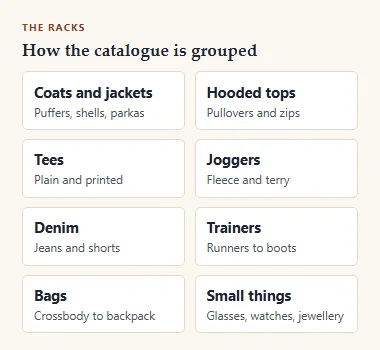
Cards grouped by the thing you wear
The CNFans Spreadsheet is a catalogue: thousands of product cards from Chinese sellers, sorted into racks such as coats, trainers, tees, bags and jewellery. You browse it the way you browse any online shop, by category or by search, and you save the cards you like.
The name is older than the thing. Early lists of finds really were plain documents, passed around and copied, and the label stuck after those lists grew into photo catalogues you can search. What matters today is how it behaves: you look at pictures, read prices, and follow a card to the listing details.
CNFans is in the name because CNFans is the agent you would use to buy what you find. The catalogue and the agent are separate things, and this site is separate from both.
A card’s face and the product page under it
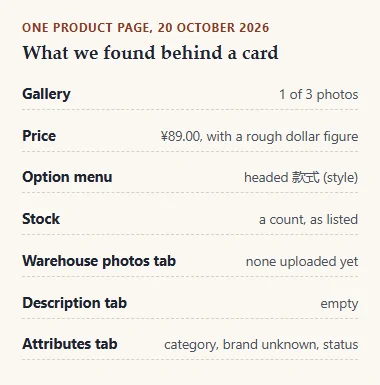
A card shows a cover photo, a title, sometimes a brand line, and a price in yuan. Tap it and you reach a product page with more. We opened one on 20 October 2026, a perfume listing, to record exactly what it held.
It had a photo gallery marked one of three, a price of ¥89.00 next to an approximate dollar amount, an option menu, a stock count, and three tabs. The first tab was for warehouse photos and said none had been uploaded yet. The second, a description, was empty. The third listed attributes: the category, a brand field set to unknown, and a status.
That is typical. The card gives you enough to decide whether to look further; the product page gives you enough to start the second cut. Neither tells you how the item will fit or feel.
Where the cards come from
Every card points back to a real listing in a Chinese online shop. The catalogue address for a card ends in a code beginning “w-”, and the digits after it are the item number on the seller’s platform. Copy that code into your notes: it is the quickest way to tell CNFans exactly which listing you mean.
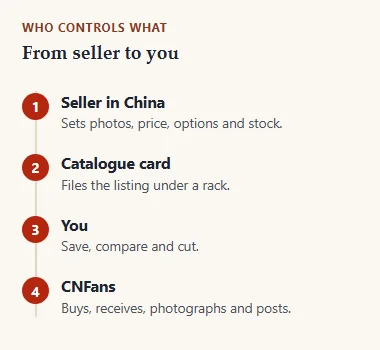
The product page itself says that it is a discovery tool and does not make or sell the items, and that purchases go through buying agents. That is the honest description. The seller sets the photo, the price, the options and the stock; the catalogue organises it; the agent buys it.
Because the seller controls the listing, it can change after you save the card. Prices move, sizes sell out and photos get swapped. Recheck on the day you order.
What the catalogue is not
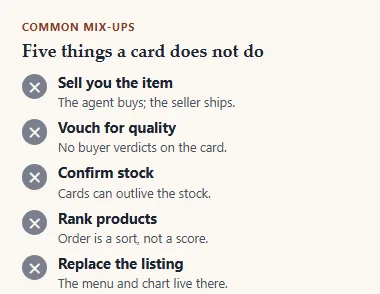
It is not a shop. You cannot pay the catalogue, and nobody there will post you anything. It is not a review site: a card says nothing about whether earlier buyers were happy. It is not a stock check: a card can stay up after the seller’s last item has gone.
It is not a ranking either. The order cards appear in is a sort, and the labels some cards carry describe price or newness, not quality. And it is not a document of rows to download: if someone sends you a file and calls it a spreadsheet of finds, that is a different and much older thing.
Knowing what it is not saves you from the most common disappointment, which is treating a nice photo as a promise.
Why people search for top finds, and what they get here
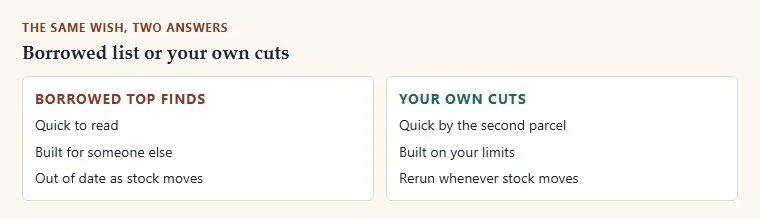
People type “top finds” because they want a shortcut: someone else’s verdict on which cards are worth it. That is a reasonable wish. The trouble is that the verdict was made for someone else’s body, budget and patience, at a moment when the seller had different stock.
This site gives you the shortcut in a form that keeps working: a way to cut your own longlist quickly, with reasons you can recheck. It is slower than copying a list for the first parcel. By the second, most people find it faster.