Every category rack in the CNFans Spreadsheet, and the checks each one needs
This is the catalogue laid out rack by rack. Start anywhere, save freely, and use the notes under each group to decide which cards deserve a second look.
Every rack, one card each
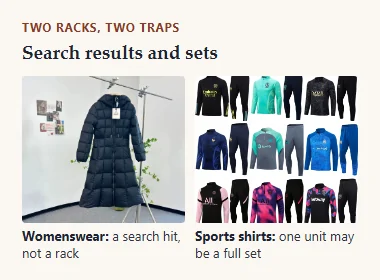
Each card goes straight to that part of the catalogue. Womenswear is the odd one out: there is no fixed women’s rack, so that card runs a search for the word instead, and the results are keyword matches you will want to narrow.
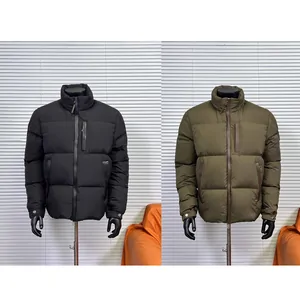 Coats and jacketsPuffers, parkas, shells and work jackets.Category
 Hooded topsPullover and zip hoodies, sweatshirts.Category
 TeesPlain, printed and heavyweight tees.Category
 JoggersJoggers, track bottoms, lounge trousers.Category
 DenimJeans, denim shorts, denim jackets.Category
 WomenswearA search for women, not a fixed rack.Search results
 Sports shirtsFootball kits, training tops, track sets.Category
 TrainersLow tops, runners, boots and slides.Category
 BagsCrossbody, messenger, tote and backpack.Category
 BeltsLeather and woven belts, buckles.Category
 Caps and hatsCaps, beanies, buckets.Category
 GlassesOptical frames and sunglasses.Category
 WatchesWatches, straps and pocket pieces.Category
 JewelleryChains, pendants, rings, earrings.Category
 PerfumeFragrance bottles and gift sets.Category
 ElectronicsEarbuds, cases, chargers, speakers.Category
How a rack page is put in order
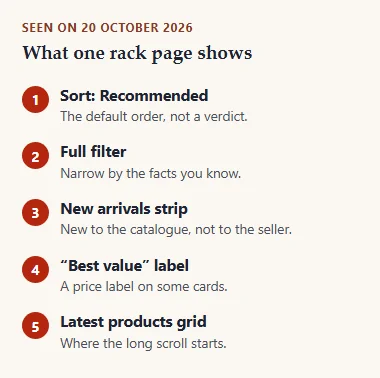
We opened the hooded-tops rack on 20 October 2026 to see what a category page actually shows before you scroll. It opened on a sort called Recommended, with a full filter option next to the sort, a strip of new arrivals near the top, a “Best value” label on some cards and a longer grid of latest products below. Prices were in yuan to two decimal places, and some cards carried a brand line above the title.
None of that is a judgement on quality. Recommended is a sort order; new arrivals are new to the catalogue, not necessarily new to the seller; best value is a label set by price. Treat the first screen as a random sample of the rack and scroll past it before you start saving cards.
The same logic applies to anything called top, trending or featured anywhere online. Order tells you where a card sits on a page, never whether it will fit you.
Clothing racks: coats, hooded tops, tees, joggers and denim
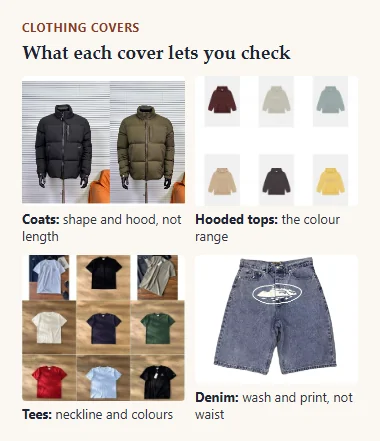
Clothing is where most longlists start and where most of them go wrong, because the card shows the look and hides the numbers. For coats, the two numbers that matter are the back length and, for puffers, any fill line in the listing photos. For hooded tops and tees, look for a fabric weight: sellers who print one, such as a gram figure on the cover, tend to know their product.
Joggers and denim live and die on the waist and the inside leg. A letter size on a card is a starting point; the size chart in the listing, in centimetres, is what you hold against trousers already in your drawer. Lay your own trousers flat, measure across the waist and double it, and you have a number the chart can answer.
Colour is the last check, not the first. Many clothing covers show one cut in six or eight colours, and the option menu names each one in the seller’s own words.
Womenswear and sports shirts
The womenswear card is a search, so what comes back depends on how sellers wrote their titles. Add a garment word to the search box, such as “women puffer” or “women knit”, and the results tighten up quickly. Check the size chart twice: some women’s listings use the same S to XL letters as men’s pieces but cut smaller, and the chart is the only place that shows it.
Sports shirts are often sold as a kit, shirt and shorts together, or as a training set with a top and trousers. Read the option menu to see what one unit buys you, and whether printing a name or number is a separate option with its own price.
Trainers and other footwear
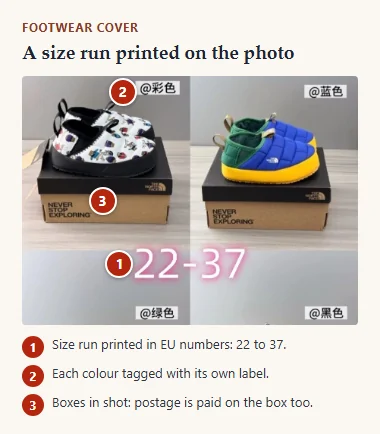
Footwear covers love to show a full colour range and say nothing about sizes. One children’s snow boot cover we opened printed “22-37” across the middle and tagged each colour with its own label in Chinese, 彩色 for the multicolour pair and 黑色 for the black. Those numbers are European sizes; check whether the option menu uses the same scale or a Chinese one before you pick.
Two more checks keep trainers on a longlist. First, the box: shoes travel in boxes that cost postage, and some buyers ask the agent to post without the box to save space. Second, the sole: a cover shot from above hides how thick it is, so look for a side view among the listing photos.
For your own size, take a shoe that fits you well and measure inside it, heel to toe, in millimetres. A size chart that gives foot length in millimetres or centimetres is far easier to trust than a column of numbers from a scale you do not use.
Bag, belt and cap listings: box space against weight
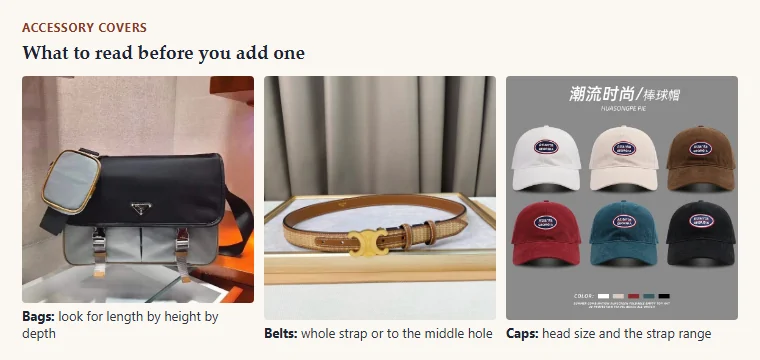
Accessories are where a longlist can save postage or waste it. Caps weigh very little and slip into any parcel; a structured bag can be light but take up a lot of box. When a bag listing gives dimensions, it usually gives them as length by height by depth in centimetres. Hold a ruler up to a bag you own before you decide a 25 cm crossbody is the right size.
Belts are sold by length, and the length a seller means can be the whole strap or the distance to the middle hole. Caps are sold by head circumference, often with an adjustable strap that covers a range. If the listing does not say which, ask before you buy.
Glasses, jewellery and watches
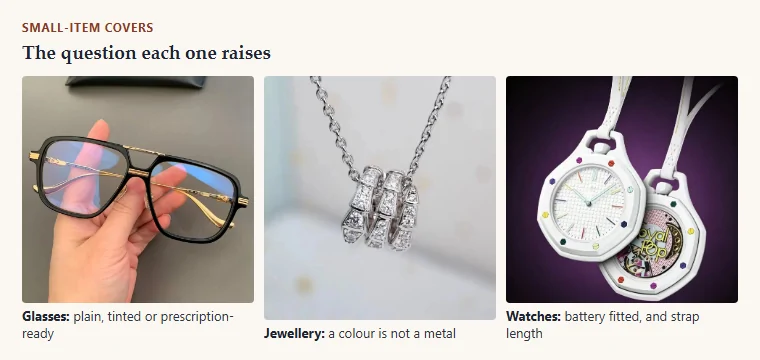
Small things hide their details best. For glasses, the frame width and the lens are what matter: a listing should say whether the lenses are plain, tinted or ready for a prescription. For jewellery, ask what the metal is. Sellers tend to write a colour, such as gold or silver, where you need a material, such as stainless steel or plated brass, and the difference shows after a month of wear.
Watches bring two extra questions: whether a battery is fitted, which some shipping lines will not carry, and how long the strap is. Ask CNFans which line takes a watch with a battery before you add it to a longlist.
Perfume and electronics ask a shipping question first
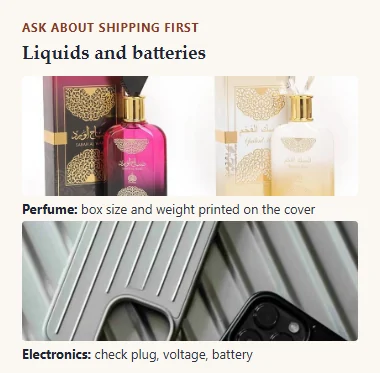
These two racks come with a shipping question before a style question. Perfume is a flammable liquid, and electronics usually carry batteries; plenty of international lines refuse one or both, and the ones that accept them often cost more. Settle which line can take the item before you buy it, or it may sit in the warehouse with nowhere to go.
The perfume cover we opened printed its own box size and weight, which is exactly the information a shipping line will ask about. For electronics, look for the plug type and the voltage in the listing; a charger built for a Chinese socket needs an adaptor, and some need more than that.