
Every yuan on a CNFans order, and every gram in the parcel
A catalogue price is the start of a total, not the end. This page goes line by line, in the sequence they reach you, and works the sums on a real cover photo.
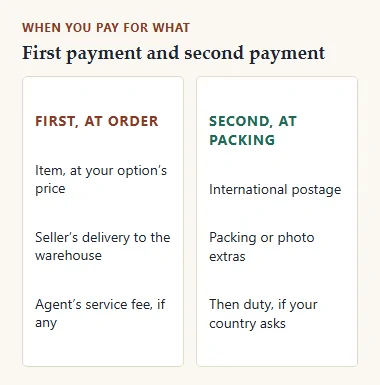
First payment, second payment: what each pays for
An agent order is paid in two goes, and each covers different lines. The first payment, when you place the order, covers the item at the price of your chosen option, the seller’s delivery fee to the warehouse, and any service fee the agent charges for buying. The second payment, when your items are packed, covers international postage and any optional packing or photo services you asked for.
CNFans’ captured help centre had a heading on service fees, but the text under it was never captured, so this guide prints no CNFans fee. Read the fee line on your order total before you confirm, every time.
A third cost may come later, from your own country: duty, import tax or a handling charge collected by the carrier. That one depends on where you live and what is in the parcel, not on the agent.
Paying in yuan from a pound, euro or dollar account
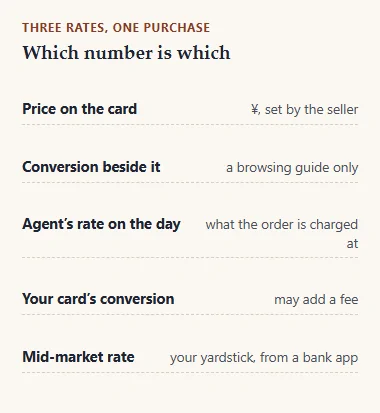
Catalogue prices are in Chinese yuan, written CNY or with the ¥ sign. On the product page we opened on 20 October 2026, a price of ¥89.00 sat beside a rough dollar figure. That figure is a guide for browsing. The exchange rate you are actually charged is set by the agent when the money moves, at top-up or at payment, and your card provider may add its own conversion fee on top.
To see how far the agent’s rate sits from the market, note the yuan amount and the amount in your currency on the payment screen, divide one by the other, and compare it with the mid-market rate in your banking app the same day. A small gap is the price of the service. A large one is worth asking about.
Keep the budget in yuan while you cut the longlist. Converting every card makes small differences look bigger or smaller than they are.
Weight, and box size counted as weight
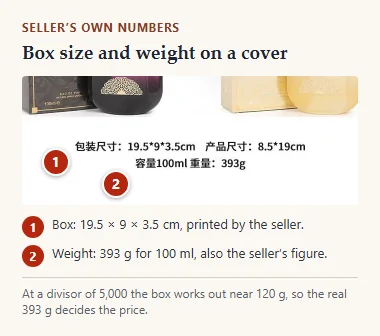
International postage is priced on weight, but a big light box costs the line as much space as a small heavy one. So lines also work out a volumetric weight: length times width times height in centimetres, divided by a number the line publishes. Many express services divide by 5,000 or 6,000; your line will state its own. You pay on whichever weight is higher.
The perfume cover we opened on 20 October 2026 printed its box as 19.5 × 9 × 3.5 cm and its weight as 393 g. The box comes to about 614 cubic centimetres, which divided by 5,000 is roughly 120 g, so the real 393 g would decide the price. A boxed puffer jacket works the other way: light, but big enough that its size can count for more than its weight.
Packaging to strip before weighing
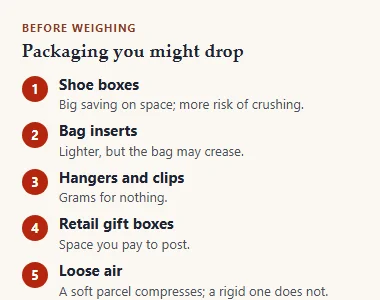
Before the parcel is weighed you can usually ask for packaging to come off. Shoe boxes are the big one: a pair of trainers in a box can take more space than the trainers themselves. Hard inserts in bags, plastic hangers and thick retail boxes add grams and centimetres for nothing you will keep.
Removing packaging has a cost of its own. A shoe without a box is more likely to be squashed in transit, and a bag without its insert can crease. Decide item by item. And remember that some lines charge for size more than weight, so a soft parcel that can be compressed is often cheaper than a neat rigid one.
Picking the line your parcel travels on
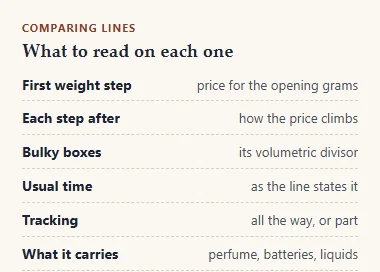
An agent offers several international shipping lines, each a route with its own carrier, price steps and rules. Compare them on your packed weight, not on a guess. The things that separate them are the price for the first weight step and each step after, how they treat bulky boxes, how long they usually take, whether they track all the way, and what they will carry; perfume, batteries and liquids narrow the choice fast.
The captured CNFans site had an Estimation page in its top menu. When the shop is back, run your packed weight and box size through it for each line and keep a screenshot of the result next to your order.
Storage while slower finds catch up
Items rarely arrive together. The first may wait at the warehouse for a week or more while the last seller gets round to posting. Agents store items for a period and may charge after it. CNFans’ captured help centre had a Storage heading with no text captured, and its front page wording on storage changed between captures, so we print no number. Ask CNFans before you order a slow item.
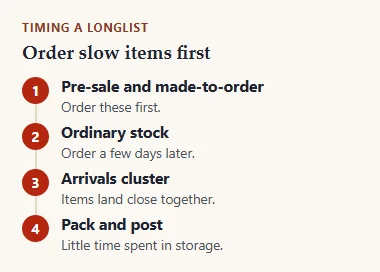
The practical fix is timing. Order the slow items first, such as pre-sale pieces, and the quick ones later, so everything lands within a short window and nothing sits waiting for weeks.
Duty, tax and the border
When a parcel crosses into your country, you are the importer. Whether duty or import tax is due, and how much, depends on your country’s rules, the value and the kind of goods. The carrier that delivers the last leg usually collects any charge before handing the parcel over, and may add a fee for doing so.
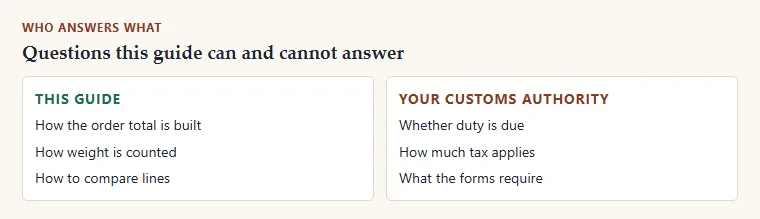
This guide does not give customs advice and will not tell you what to write on any form. For your own case, read the import pages of your government’s customs or tax authority, and pay any charge only through the carrier’s own site or app.
Keep the weight estimate and the carrier bill separate
A planning list with 800 g shoes, a 600 g jacket and a 200 g shirt totals 1.6 kg of estimated item weight. It is not a 1.6 kg parcel quote. Packaging adds weight; box dimensions can also change the billed figure under the chosen line’s rules.
For an illustrative comparison, imagine a line uses length × width × height ÷ 6,000 with centimetres. A 40 × 30 × 25 cm box then gives 5 kg volumetric weight. A different divisor or rounding rule changes that number. Use the divisor and weight increments actually shown for your route, and compare the final packed quote instead of treating this example as a carrier policy.
Removing a shoe box may reduce volume, but a protective carton may still be needed. Keep the product’s packaging if it matters for storage, gifting or a possible return, and ask about the trade-off before authorising disposal. If a product is still under dispute, do not let a cheaper packing option make the return harder. Decide on the goods first, then optimise the parcel.