Who is actually selling the find
Behind each catalogue card is a shop in China that sets the photos, the price and the stock. Here is how to judge a seller from outside, and what to ask through CNFans.
Every card has a shop behind it
A catalogue card is a window onto one listing in one shop on a Chinese marketplace. Many of those shops are small: a few people, a stockroom, a phone for answering messages. Some make their own goods; many resell from workshops nearby. The card rarely tells you which.
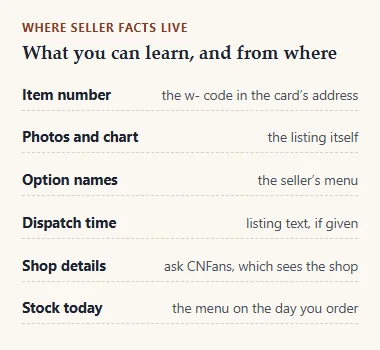
What it does give you is the item number. The card’s catalogue address ends in a “w-” code, and the digits after the dash are the listing’s number on the seller’s platform. Hand that to CNFans and its buyer can open the exact listing, see the shop it belongs to and pass on your questions.
You will almost never talk to the seller directly. Everything goes through the agent, which is one more reason to keep your questions short and exact.
Signs of a seller who knows the product
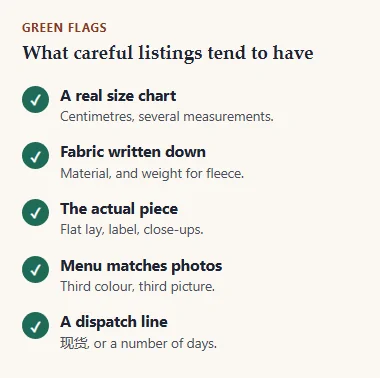
Sellers who know their product write numbers down. Look for a size chart in centimetres with more than two measurements per size, a fabric line that names the material and, for knitwear and fleece, a weight. A seller who prints “190克” on a cover is telling you the cloth weight and inviting you to check it.
Good listings also show the actual piece: a flat lay, the label, a close-up of a zip or a seam. Option names line up with the photos, so the third colour in the menu is the third colour in the picture. And there is a line about dispatch, even if it only says 现货 (in stock) or gives a number of days.
None of this proves the item is good. It shows a seller who expects to be held to what they wrote, which is the kind you want when a warehouse photo raises a question.
Signs to slow down
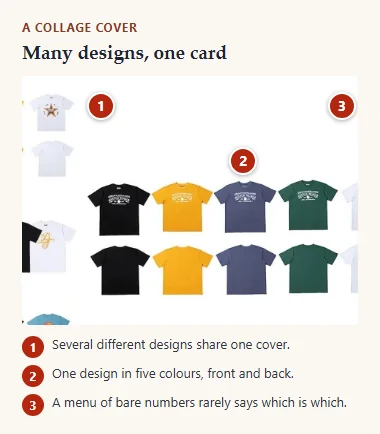
Some listings ask you to trust more than they show. The commonest is the collage cover: one card, a grid of many different designs, and an option menu that only says 1, 2, 3 and so on. Which number is which design? Often the order in the menu does not match the order in the grid, and you find out at the warehouse.
Other signs: every photo is a model or a street shot; the size chart is a single row of letters; the price sits well below every similar card with no reason given. Any one of these is a question to ask, not a verdict. Two or three together usually mean the card should be cut before you spend time on it.
If you still want a collage card, ask through CNFans for a photo of the exact design and colour you are buying, and write the menu number beside a description in your notes: “number 3, the five-colour design, green, front print”. When the warehouse photos arrive, that line is what you check them against.
Same item, several shops
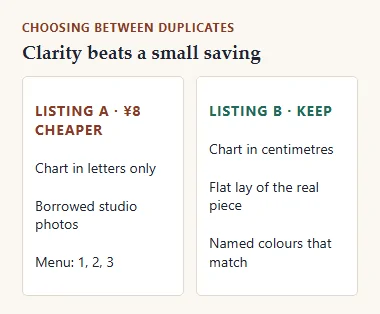
You will often save what looks like the same piece from two or three shops, sometimes with the same photos. Do not keep them all. Put the listings side by side and choose on clarity, not on a small price gap.
Pick the listing with the fuller size chart, the photos of the actual piece rather than borrowed ones, the menu whose names match the pictures and the clearer dispatch line. A few yuan saved on a vague listing is lost the moment you pay to return an item from the warehouse.
If two listings are equally clear, take the one whose seller answered your question fastest through the agent. A quick reply before the sale is a fair guide to how a problem will be handled after it.
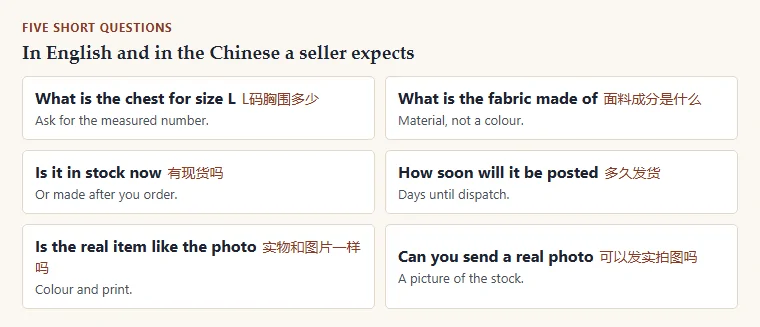
Six short questions to pass to a seller
Short questions in plain Chinese get answered fastest. Your agent will translate, but it helps to send something that needs no interpretation. These six cover most of what a longlist needs to know, and each fits on one line of an order note.
Ask one or two at a time, about the option you actually want. A seller asked about the chest of size L will measure size L; a seller asked “is it true to size” will say yes.